International Certification of Dance Studies (CID)
Authority and Role of the International Dance Council (CID)
The International Dance Council CID is the world’s leading international organization for dance and the official partner of UNESCO. As a global, non-profit, and independent institution, CID connects and validates dance education across more than 175 countries, embracing all genres and traditions of dance.
CID does not impose examinations or artistic standards. Instead, it acts as a trusted third-party authority that confirms documented dance study in a transparent and internationally recognized framework. This ensures credibility, consistency, and global comparability in dance education while fully respecting each school’s artistic and pedagogical independence.
For students, the International Certification of Dance Studies serves as a verified international record of their training, often referred to as “the dancer’s passport.” It supports academic and professional mobility, enables cross-border recognition of study experience, and empowers students to carry their artistic education forward with confidence wherever their dance journey leads.
Caution
– Various associations or even businesses appear as international organizations awarding teacher diplomas, championships, certificates, competition prizes, degrees, etc.
– Such documents have limited or no value outside their small circle and their particular country
Outline:
1. Each requires at least 150 hours, including classes, rehearsals, performances, or lectures.
2. The School Director, the school, and the student are Members of CID.
3. The School Director sends CID a form declaring that the student has completed 150 hours.
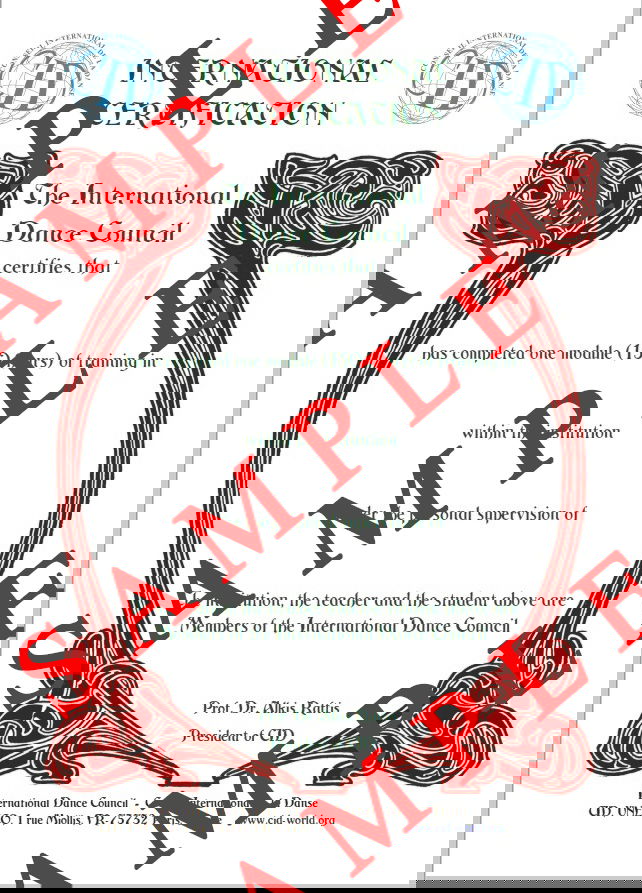
4. CID sends Certification on parchment paper. An official hands the parchment to the student at a special ceremony.
5. After Level 1, the student can proceed to Level 2 (another 150 hours), then another 150 hours for Level 3, and so on.
6 . This applies to all countries and all genres of dance.
7 . To prevent fraud, anyone can check the Global Dance Directory to see if a dance school or a person is registered or if a student is certified.
Guarantees
Only CID can offer solid guarantees since only CID is:
– official, recognized by governments, and a partner of UNESCO
– worldwide, in more than 175 countries
– independent from any influences or interests
– global, not linked to any particular country
– strictly non-profit, accepting no money other than membership fees
– democratic, governed by elected officers
– established, with a long history of 50 years
– competent, bringing together top-level specialists
– encompassing all genres of dance and all professions
Characteristics
– Uniformity: same for all countries.
– Verification: inquiries on certified students are confirmed by CID.
– Security: certificates are issued centrally, by the CID Secretariat
– Selection: schools, teachers, and students are members of CID
– Equality: all genres of dance and all approaches
– Stability: will never change
– Flexibility: can be given in addition to other qualifications
– Gratuity: free of charge to members
Student data for Certification
Please send one form for each student/dancer you nominate for the International Certification of Dance Studies.
Full name of student (indicate Mr. or Ms..):
Postal address of student:
Email address of student:
Fixed telephone:
Mobile telephone:
Type of dance:
Level:
Name of school:
Name of teacher:
Notes for the School Director
– Certification is FREE OF CHARGE to Members. Total cost is only membership fees: 70 euros for the school director, + 140 euros for the school, + 70 euros for each student
– Data in bold characters above will be printed in English on the Certification parchment. Make sure spelling is correct.
– Genre of dance must be one only, for example: ballet, tango, ballroom, or dance therapy, etc., in English.
– Level must be a number from 1 to 10. Each level is 150 hours. Only one Certification in a year for a given genre of dance.
– Documents are sent to the school, never to students.
Procedure for International Certification of Dance Studies
1. The School Director is admitted to CID as a Member
2 . The school is admitted to CID as a Member.
3 . The School Director sends a filled form for each student who has completed 150 hours.
4 . The students are admitted to CID (as Youth Members if they are aged under 16).
5. CID sends the International Certification to the school.
6 . The School Director or an important city personality hands the Certification to students at a special ceremony.
7. A student can continue for another 150 hours, for example: Ballet Level 5, Tango Level 2, Dance Therapy Level 3.
8. Assuming 40 working weeks in a year:
4 hours a week x 40 weeks = 160 hours, that is a Level in 1 year
2 hours a week x 40 weeks = 80 hours a year, that is a Level in 2 years
1 hour a week x 40 weeks = 40 hours a year, that is a Level in 4 years.
9. Certification awarded after verified study and level assessment.
Guidelines for International Certification
1. We need full data for each student, including:
– Write Mr. or Ms. (we are not familiar with all names).
– Write given names before family names, or family names in capital letters. Use the full name as it appears on the identity card. Use the Roman alphabet (no accented letters).
– Provide the full postal address, email, and phone numbers (note if it is a mobile phone).
– Specify the genre of dance, such as Ballet, Chinese Classical Dance, Chinese folk Dance, Bharatanatyam, Ballroom, Bellydance, etc. Use internationally accepted terms. Do not use terms such as advanced, professional, intermediary, teacher, etc.
– The level is only a number: 1, 2, or 3 (up to 10). A level corresponds to at least 150 hours of classes.
2. Age of student
– The student must be at least 7 years of age on the day of the awarding ceremony. There is no maximum age.
3 . Only one Certification in a year
– Even if the student has completed 300 hours that year in the same dance genre, they can only receive one Certification.
– A student can have two Certifications if they have completed 150 hours in each of two genres of dance in the same year.
4. School requirements
– The School Director can decide not to award Certification after 150 hours, or ask the student to follow additional classes or pass an internal examination
5. School requirements
– The School Director can decide not to award Certification after 150 hours, or ask the student to follow additional classes or pass an internal examination
6. Same school
– The student should have attended all classes at the same school
– All names on the Certification must be CID Members
7. Content of the 150 hours
– They can include hours of class, rehearsal, performances, examinations, and theoretical lectures (theory, anatomy, dance history, etc.)
– The School Director can give credit for studies outside the school (other genres of dance, university degrees, performance experience, etc.) or online classes
– The Director defines the requirements to grant a Level (150 hours is a minimum)
– CID strives to standardize the organization (not the content) of dance studies in all countries and all genres of dance.
8. Government recognition
– CID is in touch with National Delegations at UNESCO and Ministries of Culture or Education regarding the recognition of the International Certification by governments
9. Caution
– Various associations or even businesses appear as international organizations awarding teacher diplomas, championships, certificates, competition prizes, degrees, etc.
– Such documents have limited or no value outside their small circle and their particular country
Safety Measures for International Certification
This document is very important; we take measures to ensure it is difficult to forge, copy, or for someone to falsely claim that they have it.
1.It is printed on special parchment paper
2. Names of recipients are listed online so everyone can check
3. The School Director can confirm if a person has attended the school
4. The CID Secretariat replies to inquiries in case of doubt.
5 . Read details at: https://cid-world.org/